
Discovering the Enchantment of the Scottish Borders: A Journey Through Time
The Scottish Borders has always felt like a place where history is very close to the surface. You can feel it walking the hills, crossing the old stone bridges, and standing in the shadow of the ruins that dot the landscape in every direction. Centuries of conflict along the Anglo-Scottish frontier left behind a remarkable collection of castles, towers, and fortresses, many now abandoned to the weather and the brambles. We love sharing these places with our guests, and this is our guide to the most atmospheric of them all.
The Scottish Borders: Where History Left Its Mark
For several centuries, the Scottish Borders was one of the most fought-over strips of land in Europe. The region formed the disputed frontier between Scotland and England. It was patrolled by the Border Reivers, the notorious cattle-raiding clans who owed allegiance to no one and terrorised both sides of the border from the 13th to the 17th centuries. The result is a landscape littered with defensive architecture: peel towers built for quick retreat, great curtain-walled castles built to dominate, and the ruins of fortresses that changed hands so many times their stones eventually gave up entirely.
If you enjoy history with a side of atmosphere, the Scottish Borders will not disappoint. We have put together our favourite castle and tower stops, all within a comfortable day's drive from Bowden House.
Smailholm Tower, Near Kelso

Smailholm is the one that tends to stop people in their tracks. This slender 15th-century peel tower rises from a rocky outcrop above a small loch, utterly alone on the moorland. It is silhouetted against whatever sky the Borders is throwing at you that day. It is one of the most photogenic spots in all of Scotland, and the view from the top across the Tweed Valley to the Cheviot Hills is exceptional.
Smailholm was the childhood haunt of Sir Walter Scott, who spent summers nearby and credits the tower with sparking his lifelong obsession with Border history and legend. Today, it is managed by Historic Environment Scotland and open to visitors seasonally. The small exhibition inside is worth the admission. It is roughly 20 minutes from Bowden House by car.
Cessford Castle, Near Jedburgh

Cessford is less visited than Smailholm, which is exactly part of its appeal. The ruined stronghold of the Ker family, one of the most powerful Reiver clans, sits in open farmland south of Morebattle. It requires a short walk across a field to reach. What greets you is genuinely impressive: thick sandstone walls still standing to several storeys in places, an atmosphere of complete abandonment, and almost no other visitors.
The castle was described by the English as one of the three strongest fortresses in Scotland in the 16th century. It was besieged, surrendered, and partially demolished during the pacification of the Borders. Today it is freely accessible, listed but unmanaged, which gives it a quality that more curated sites often lack. Allow time to explore and bring decent footwear.
Hume Castle, Near Kelso

Hume Castle crowns a prominent hill near Greenlaw and is visible from miles around, which was very much the point. The original fortress on this site dates to at least the 13th century and was home to the powerful Home family. What stands today is largely a romantic reconstruction from the early 19th century, but the hilltop location is genuinely dramatic, and the views in every direction are spectacular.
At dusk, the outline of Hume against the fading light is one of those sights that stays with you. There is something genuinely eerie about it, particularly in the late afternoon when the surrounding farmland is quiet. The site is freely accessible, and the short climb to the top is well worth it.
Hermitage Castle, Liddesdale

If you can visit only one castle in the Scottish Borders, make it Hermitage. Known as the Strength of Liddesdale, this enormous 14th-century fortress crouches low in a remote valley near Newcastleton, surrounded by moorland and the sound of the burn running past. It is as brooding and forbidding as any castle in Scotland, and its reputation more than lives up to the appearance.
Hermitage was associated with some of the most turbulent figures in Border history. It was here that Mary Queen of Scots famously rode 50 miles on horseback in a single day to visit the wounded Earl of Bothwell. Legend holds that the castle is so soaked in violence and dark deeds that the earth itself refuses to let it sink. Ghost stories are plentiful. The castle is managed by Historic Environment Scotland and is well worth the drive. Plan for a half-day.
Roxburgh Castle: Scotland's Forgotten Fortress
Roxburgh is one of Scotland's great historical mysteries, a castle so thoroughly destroyed that almost nothing remains above ground. The site sits on a promontory at the confluence of the Tweed and the Teviot, just outside Kelso. Today, it looks like nothing more than a series of grassy humps and earthworks. But this was once one of the four most important burghs in medieval Scotland, and the castle was a prize fought over repeatedly by English and Scottish forces.
James II of Scotland was killed here in 1460 when a cannon exploded next to him during a siege. History enthusiasts will find the site fascinating for what it represents, even in the absence of standing remains. The walk along the riverbank to reach it is beautiful in its own right.
Floors Castle: The Grandest of Them All
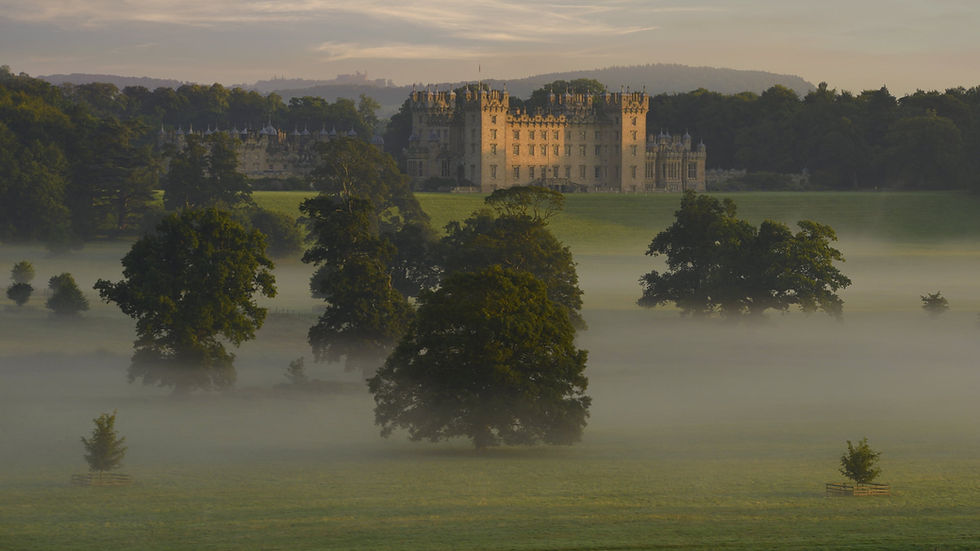
Not all the great houses of the Borders are ruins. Floors Castle, just outside Kelso, is the largest inhabited castle in Scotland and the seat of the Duke of Roxburghe. It is a very different experience from the atmospheric ruins listed above, but well worth including on any Borders castle tour.
Floors is open to visitors in season, and the grounds are particularly lovely. In summer 2026, the estate is hosting an immersive Jungle Book performance on 11 July, which makes for a brilliant evening out. You can find details and more upcoming events on our See and Do page.
Planning Your Castle Trail from Bowden House
Bowden House sits in an ideal position for exploring all of these sites. Smailholm and Hume Castle are under 25 minutes by car. Cessford and Roxburgh are around 35-40 minutes. Hermitage is the furthest at roughly an hour, and we would suggest combining it with a longer Liddesdale day. Floors Castle is just over 30 minutes.
A few practical notes: Smailholm and Hermitage are Historic Environment Scotland properties and charge a small admission fee, with seasonal opening hours. Cessford, Hume, and Roxburgh are freely accessible at any time. Good walking shoes are useful at all of them, and layers are always sensible in the Borders, regardless of the season.
If you are planning a history-focused trip, we are very happy to help put together an itinerary. We know the area well and can point you towards the less-visited spots that do not make it onto the usual lists. Check availability for your preferred dates on our bookings page, and do get in touch if you have any questions.
The Magic of the Scottish Borders
The ruins of the Scottish Borders have a quality that is hard to describe until you have stood in them. They are not theme park history. They are the real thing—quiet and often completely empty—and they reward the visitor who takes the time to find them. We would love to welcome you to Bowden House and send you off each morning with a proper breakfast and a route to somewhere extraordinary. We look forward to hearing from you.

Comments